History of the 48th Highlanders of Holland Pipes and Drums

The 48th Highlanders of Holland Pipes and Drums, as our full name is, was founded on January 15, 1991. A group of enthusiastic locals then took the initiative to erect a living monument. A monument because they wanted to give something back to the liberators of Apeldoorn and the surrounding area.

This town and its surroundings were liberated in the first half of April 1945, primarily by the Canadian army, with a key role reserved for the regiment named the 48th Highlanders of Canada. This regiment had its own pipe band, and the band's members also fought their part in the fighting.

Many of them fell here in those April days, giving their lives for our freedom. Every year, veterans from Canada still come to our country and our region to commemorate and remember them. Because we cherish our freedom and want to give something back, our motto is: "We do remember." Because we never want to, and must never, forget...

Ross Stewart
Pipe Major J. Ross Stewart from Toronto was the man approached in 1993 by chairman and founder Gerrit Ham to instruct our band in music, drill, uniform, and deportment. Although Ross had been Pipe Major of the famous 48th Highlanders of Canada, Pipes and Drums, for 10 years, the small, fledgling Dutch band was also dear to him. For many years, he visited Apeldoorn in April at his regular lodgings with the Bosman family, and with great patience and humor—yet with a firm hand—he got things on the right track. He could tell endless stories about his experiences during World War II and about pipe band music, and with his engaging personality, he knew how to motivate many a new band member. He organized the commemorations at the Canadian cemetery on Holterberg, attended the lighting of the liberation flame in Oranjepark, and marched or rode in the large parades, waving and shouting, "I'M BACK!!" He also visited schools to talk about the war, after which he entertained everyone with funny games and Dutch bagpipe songs like "Sarie Marijs," "Daar bij die molen" (There by the mill), and even "Zie ginds komt de stoomboot" (Look there comes the steamboat)! From Canada, he was always willing to provide information and advice, and whatever we needed, from him or the Regiment, it was immediately taken care of. He was proud to help us become a Living Monument to those who fought for our freedom during World War II. After a period of declining health, he passed away in January 2001. His name and the many fond memories we have will always be inextricably linked to our bond.
Clothing
Our uniform is virtually identical to the uniform worn by the Canadians at the time.
They also wore (and still wear) two different kilts. The pipers wear the kilt of the Stewart of Fingask, and the drummers that of the Davidson clan.
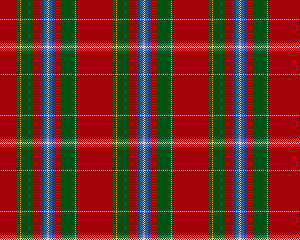

Each clan has its own tartan (pattern). There are over 30,000 different tartans known worldwide. The links below will take you to interesting websites about tartans.
By the way, did you know that a kilt contains about 7 meters of fabric and weighs several kilos?
Commemoration Holten
During the annual commemoration at the Canadian War Cemetery in Holten, we remember all fallen Canadians, and in particular the members of the 48th Highlanders of Canada Regiment, which is the namesake of our band.
48th Highlanders of Canada
Since its inception in 1891, the 48th Highlanders of Canada has built a long tradition in its home city, Toronto. Over its more than 100 years of existence, the Regiment has participated in a wide range of activities within the city of Toronto, in addition to fulfilling operational duties worldwide. Since its inception, the men and women of the Regiment have been among the first to report for duty when the national interest is at stake. The Regiment has served in Operation Recuperation, on the Golan Heights, in Korea, South Africa, Cambodia, Cyprus, Bosnia, and, of course, in the World Wars and the Boer War. The Regiment also served as the Guard of Honour for the G7 Summit in 1988, as well as the full Royal Guard of Honour for the visit of Her Majesty Queen Elizabeth II in 1998 and for the Royal Winter Exhibition. The Regiment's Band has made a name for itself in remote corners of Prince Edward Island and throughout the United States and is in high demand as a living example of the charisma and attire of Highland traditions. In short, the members of the 48th Highlanders of Canada are proud Canadians, citizens and soldiers alike. Their bonds of friendship extend across the ocean to the allied regiment "The Highlanders" (formerly the Gordon Highlanders), and regular exchanges of small units take place. We are particularly proud of our relationship with the 48th Highlanders of Canada. Our ties with the Canadian pipers and drummers were certainly strengthened by the band's visit to the Netherlands in 2000.
